

Options Trading Explained for Beginners
Options trading has become one of the most popular trading methods in the Indian stock market. Many traders use options to profit from market movements or to manage risk.
However, beginners often find options trading confusing because of the different terms involved.
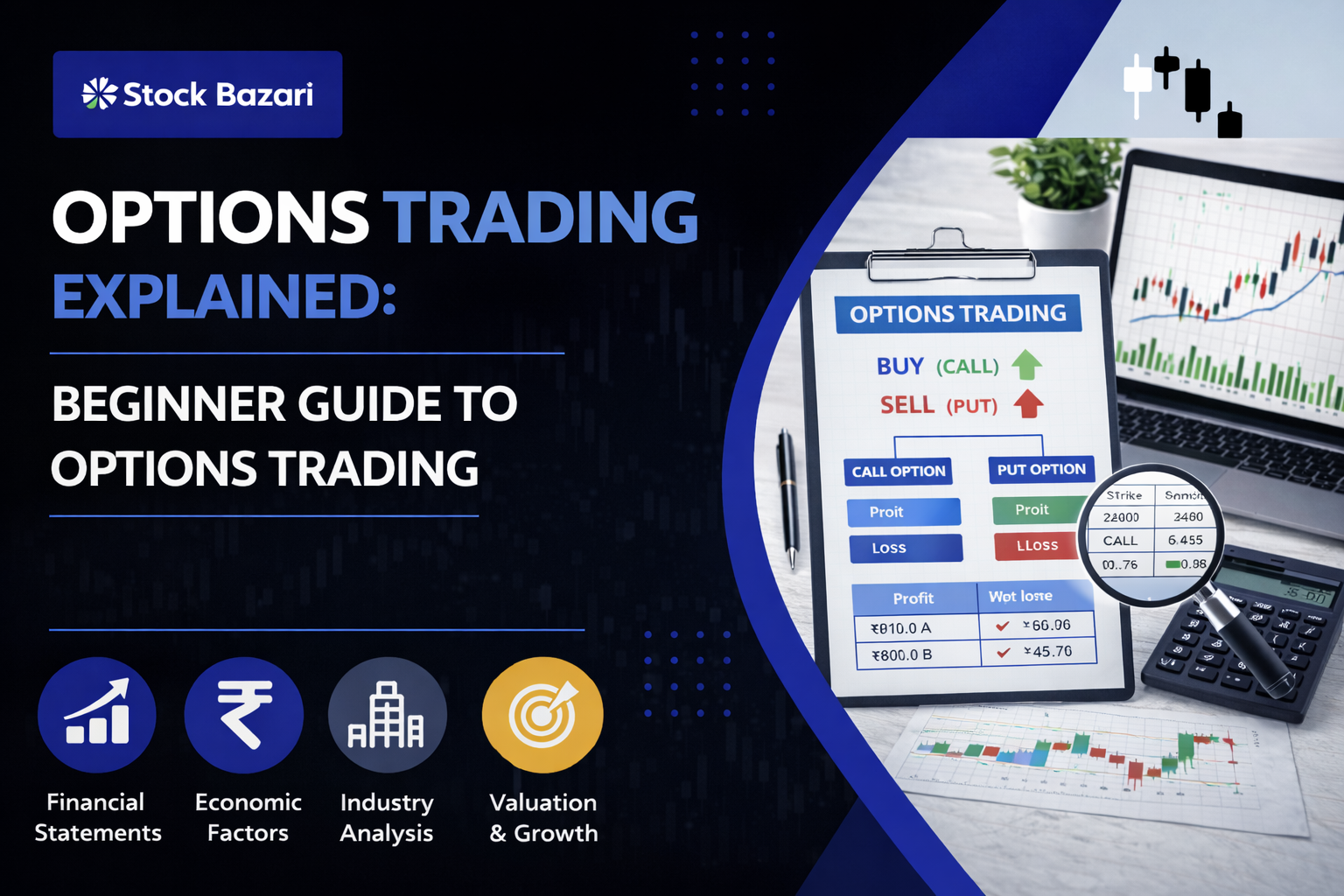
In simple words, options trading is a type of trading where traders buy or sell contracts that give them the right to buy or sell a stock at a specific price before a certain date.
These contracts are called options.
Options trading is commonly used in index trading such as Nifty and Bank Nifty.
What is Options Trading?
Options trading is part of the derivatives market.
Instead of buying the actual stock, traders buy a contract that represents the right to trade that stock at a fixed price.
An option contract has two important elements:
Strike Price – The price at which the stock can be bought or sold.
Expiry Date – The last date on which the option contract is valid.
If the market moves in the expected direction, traders can make profits from the price change of the option contract.
Types of Options in the Stock Market
There are two main types of options used in trading.
Call Option
A call option gives the trader the right to buy a stock at a fixed price before the expiry date.
Traders usually buy call options when they expect the price of the stock or index to increase.
Example:
If a trader believes the market will go up, they may buy a call option.
Put Option
A put option gives the trader the right to sell a stock at a fixed price before the expiry date.
Traders buy put options when they expect the market price to fall.
This allows traders to profit even when the market goes down.
How Options Trading Works in India
Options trading in India happens through stock exchanges such as the National Stock Exchange (NSE) and Bombay Stock Exchange (BSE).
Traders can trade options on:
- Stocks
- Indices like Nifty
- Bank Nifty
To start options trading, a trader needs:
- A Demat account
- A Trading account
- Approval for derivatives trading from the broker
Options trading requires an understanding of market movements, volatility, and trading strategies.
Example of Options Trading
Let’s look at a simple example.
Suppose the Nifty index is at 20,000.
A trader believes the market will rise.
They buy a call option with a strike price of 20,100.
If the market rises above this level before expiry, the value of the option contract may increase.
The trader can then sell the option and make a profit.
However, if the market does not move as expected, the trader may lose the premium paid for the option.
Benefits of Options Trading
Options trading offers several advantages for traders.
Some benefits include:
- Lower capital requirement compared to buying stocks
- Opportunity to profit in both rising and falling markets
- Ability to hedge investment risks
- Multiple trading strategies available
Because of these benefits, options trading is widely used by professional traders.
Risks of Options Trading
Although options trading can be profitable, it also involves risks.
Some common risks include:
- High market volatility
- Complex strategies for beginners
- Rapid loss of option value near expiry
- Emotional trading decisions
Without proper knowledge, traders may lose their capital quickly.
This is why learning options trading properly is very important.
Tips for Beginners in Options Trading
If you are new to options trading, follow these simple tips.
- Start with small positions
- Learn basic options strategies
- Focus on risk management
- Avoid trading based on tips or rumors
- Practice with paper trading before using real money
Consistent learning and discipline are key to success in options trading.
Conclusion
Options trading is a powerful tool in the stock market that allows traders to profit from price movements without directly owning stocks.
However, because it involves derivatives and complex strategies, beginners should take time to understand how options work before trading.
With the right knowledge, practice, and risk management, options trading can become an important part of a trader’s strategy.